Learn the task. Ground the image. Maintain the state.
On eight held-out mazes at the same difficulty, text-based primitive control reaches 78 / 96 normal-start clears (81.25%). Visual adaptation and fixed-weight harness comparisons then show why reading, state maintenance, and execution must be measured separately.
Anonymous review companion · updated 15 November 2026 · English paper: 7 main / 27 total pages
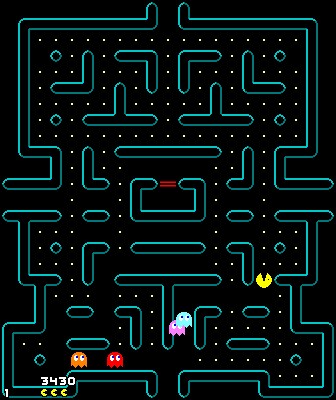
A recorded diagnostic observation№ 59
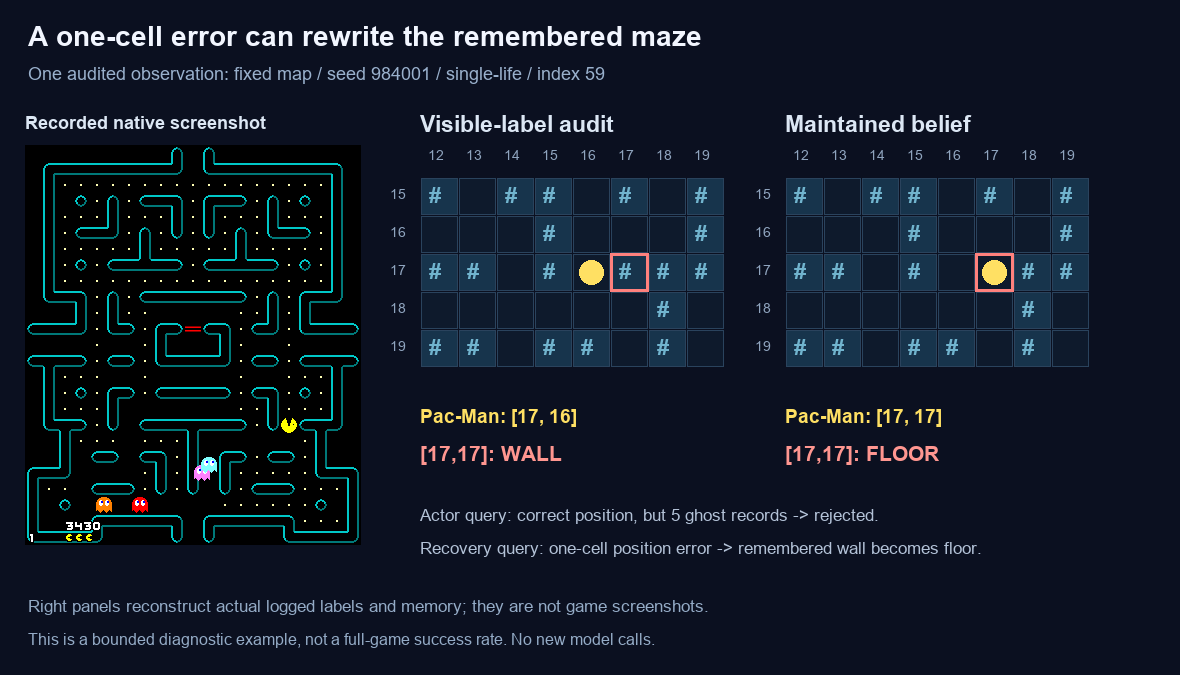
[17,16] → [17,17]One cell changes the remembered maze.A corrected current reading need not repair previously corrupted terrain.Inspect the recorded evidence ↗
THE CENTRAL PRINCIPLE
Diagnose the failure. Then choose the intervention.
Four research steps. Different information sources.
STEP 1
Text-based primitive control
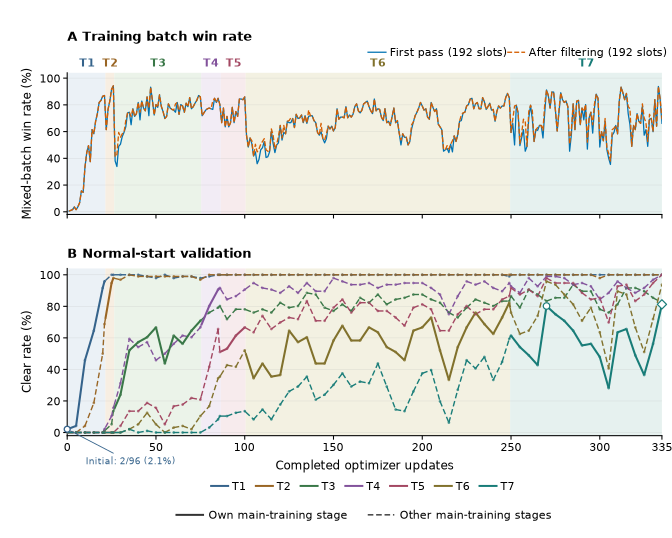
Learn U/D/L/R decisions through T1–T7, with a small rehearsal share only for the immediately preceding tier. Failure-state restarts begin only in T7. Evaluate full games from normal starts on held-out layouts.
T1–T7: curriculum tiers within Step 1
STEP 2
Visual grounding + assisted routes
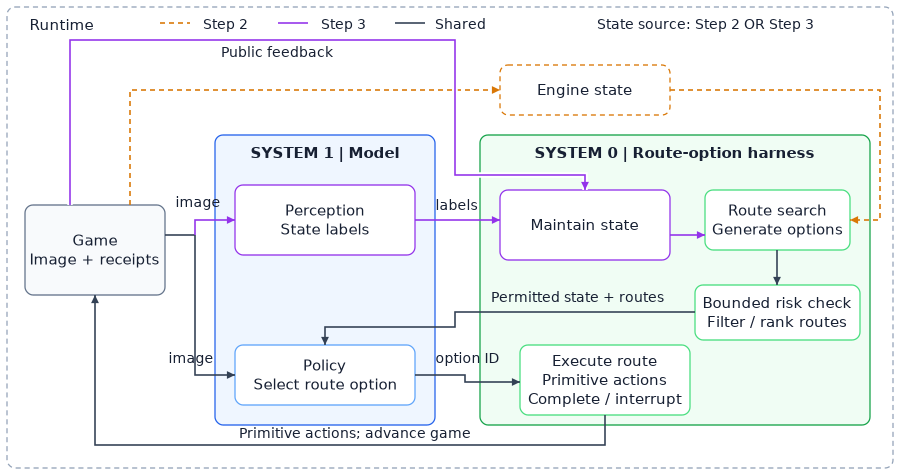
Adapt the visual reader. Engine state supports candidate generation and bounded risk checks; the model selects routes from screenshots and permitted summaries.
Orange dashed state-source branch
STEP 3
Observation-driven state
Use screenshots and public feedback to maintain allowed spatial state. Diagnose persistent map errors and missing ghost-motion inputs.
Purple solid state-source branch
STEP 4
Joint policy–harness improvement
A direction for controlled future work: improve learning objectives and runtime support together, while keeping information access and evaluation budgets explicit.
Research direction, not a new reported gain
Current paper Figure 3. One state source per instance: Step 2 or Step 3, not both. The later route-generation, bounded-check, model-choice and primitive-execution loop is shared at the functional level; versions retain their own rules.
Steps are not tiers. Step 1–4 describe the research trajectory; T1–T7 are training curriculum tiers. System 0 is runtime support, System 1 is the learned model, and System 2 is the investigator outside the execution loop. Private audit truth is not a Step 3 policy input.
02 / Main findings
Progress has more than one unit.
01
Transfer within the trained difficulty.
Checkpoint 335 clears 78/96 normal-start attempts on eight held-out layouts, compared with 0/96 for the pretrained final-stage baseline. The same validation panel supports monitoring, checkpoint selection and reporting.
A separately sampled mixed-start batch clears 192/192. Of its 132 final-tier restarts, 96 start with at most 15 of the original 118 pellets remaining; 48 start with one. Normal-start evaluation tests the missing earlier route.
Exact map transcription rises from 48.2% to 80.4% on one screenshot stream. With adapted weights fixed, control changes raise single-map three-extra-life completion from 40/64 to 62/64.
One local reading error overwrites a wall in memory. In a separate 431-state diagnostic, correct player and pellet positions coexist with missing ghost headings that constrain route checks.
These panels measure different tasks and populations. They are not a common leaderboard.
8 HELD-OUT LAYOUTS × 12 SAMPLES / NORMAL RESETS
0/96 → 78/96 on the same-difficulty panel.
Text-based primitive-action control, three extra lives and a 512-environment-action cap. A clear collects all ordinary pellets. These are repeated samples on eight layouts. The panel is reused for monitoring, selection (including checkpoint 335) and reporting; it is not an independent final test. The per-training-sample map manifest remains incomplete.
Paper Figure 2. Upper panel: first-pass and filtered training summaries (192 slots each). Lower panel: normal-start validation. T1–T7 are curriculum tiers, not research steps.
Transfer beyond direct rehearsal. After main training moves to T7 at update 250, only T6 receives a small rehearsal share. T4 and T5 receive no further direct training, yet improve from 91/96 and 83/96 clears at update 249 to 96/96 each at 335.
Different remaining tasks. In the separately sampled batch-333 audit, 192/192 first-pass attempts win without rejected groups, but the restart attempts reuse eleven states from two training maps and three source episodes. This batch is separate from the plotted restored lineage. High state turnover can coexist with concentrated sources.
Harder-task boundary. Independently loaded checkpoints 270 and 310 each clear 0/96 on T8, while their T7 results are 77/96 and 61/96. T8 changes geometry and the ordinary-pellet objective from 118 to 192; it does not isolate maze size.
SAME 531-ITEM SCREENSHOT STREAM / EXACT WHOLE MAPS
Adapt the visual representation, then the response interface.
First freeze language and adapt the vision encoder and merger to visible terrain and entities, retaining unknown occluded cells. Then freeze vision and train language-only LoRA on visual questions. The unit below is a schema-constrained screenshot item, not a completed game or an independent layout.
Historical checkpoint measurements on the same level-1 stream.
Visual adaptation
Exact maps
Accuracy
Single-size vision
256 / 531
48.2%
Multi-size vision
401 / 531
75.5%
Multi-size vision + language LoRA
427 / 531
80.4%
Image preprocessing, prompts and output schema form a shared contract. The executable reconstruction regenerates data; its update counts and settings are not a recovered manifest for every historical run. Exact reading and game completion remain separate measurements. The paper retains the raw-reader and closed-loop observation audits with their own frame/query denominators.
FIXED ADAPTED MODEL / 64 PAIRED SEEDS PER ARM / ONE MAP
The harness changes realized capability.
Weights, candidate generation and risk-ranked fallback are fixed. Each arm uses the same 25×21 map, four normal ghosts, no fruit, temperature 0.7 and a 512-native-step cap. Engine state assists route proposals and bounded risk checking. Extra-life budgets are reported separately.
Fixed adapted-model factorial. All entries are clears out of 64 paired execution seeds.
Execution
Route gate
0 extra lives
3 extra lives
Target replanning
Basic
7 / 64
40 / 64
Target replanning
Improved
18 / 64
59 / 64
Bound route
Basic
9 / 64
39 / 64
Bound route
Improved
27 / 64
62 / 64
Fixed-weight gain: 40/64 → 62/64 (62.5% → 96.9%) with three extra lives; 7/64 → 27/64 with zero. Binding alone changes 40→39 under basic gates and 59→62 under improved gates. Its benefit depends on gate and life conditions.
Joint system summary: base Qwen with old control clears 17/64 (26.6%); the adapted model with bound routes and improved gates clears 62/64 (96.9%) under the three-extra-life condition. This changes both model and harness. The fixed-model starting point is 40/64, not 17/64, and this single-map result does not establish cross-layout controller generalization.
Target replanning can reuse one choice for up to 8/3/6 Collect/Avoid/Eliminate moves. Binding changes execution commitment and the timing of subsequent model calls. The paper reports full two-model results and matched-success call costs separately.
4 RECORDED GAMES / 431 CORRELATED PRE-ACTION STATES
Correct locations do not provide all motion inputs.
Player positions and pellet sets are correct in these recorded states, yet 291 contain an active ghost with unknown heading. The following local substitutions change gate inputs on the same records, not newly executed trajectories.
All 431 recorded states: number in which the gate admits no tested action.
Gate input
No admitted action
Original recorded input
292 / 431
Uniquely matched headings replaced by private truth
92 / 431
Only subcell positions replaced
292 / 431
Private truth is used only for this diagnostic audit, not as a policy input. The substitution does not demonstrate a new completion rate or a full-game rescue. The separate memory case below shows why stable terrain must also be protected from transient actor-reading errors.
04 / Inspect what happened
Three demonstrations. Actual recorded evidence.
Explore the recorded game, route execution, and a map error.
DEMO 01
A complete clear, one decision at a time.
Scrub the recorded observations. The policy selects an option; the harness may continue it without another model call.
Frames 0–385 are observations before the next action. Step 386 reconstructs the recorded terminal native state. Playback speed is illustrative, not model latency.
One preliminary game: 1 / 1. The native offline replay matches 387 / 387 original frames. This is not a stable win-rate estimate.
Watch the 43-second reconstruction video
Reconstruction from recorded text-based maze observations and a recorded final native state; this is not the original engine video.
DEMO 02
One choice. Eighteen actions.
This selected segment contains one model choice followed by 17 harness continuation actions. It makes the boundary between policy selection and route execution visible.
This is an excerpt from Demo 01, not another independent sample or a comparison against an unbound control.
Recorded-state reconstruction. The 9-second presentation speed is arbitrary.
DEMO 03
When a one-cell error becomes a map error.
A primary actor query locates Pac-Man correctly but is rejected for five ghost records. Same-frame full-map recovery places Pac-Man one cell to the right, on a real wall. The maintained terrain then represents that cell as floor.
Fixed-map seed 984001, 0 extra lives, observation 59 in a 64-action diagnostic window. The left panel is an exact-replay native image; the right panels reconstruct logged labels and memory. The error at [17,17] is audited at observations 59–61, not established as permanent. Two neighboring errors are recorded separately at 61–63. · Native image ↗
A ghost also overlaps a wall in this scene, an unresolved engine anomaly. Private state is used only to score the diagnosis. This single case illustrates error propagation without isolating its frequency or effect on full-game completion.
05 / Reading the evidence
The protocol is part of the result.
Separate state sources.
Step 2 uses engine-state assistance. Step 3 derives allowed state from screenshots and public feedback. Each runtime instance enables one pathway; private audit truth is kept out of policy inputs.
Keep the unit explicit.
Layouts, repeated episode samples, screenshot items, correlated decision states and matched-success cost subsets have different denominators. A new random seed on one map is not a new layout.
Keep selection separate from testing.
The eight-layout Step 1 panel is reused for monitoring and checkpoint selection. Complete training-map manifests, independent reporting layouts and repeated training seeds would strengthen the result.
Preserve timing and intervention scope.
Model inference pauses game advancement. Environment steps, model choices and perception queries are different counts. Local replay/substitution audits do not establish full-game causal repairs or real-time play.
THE NEXT CONTROLLED COMPARISONS
Improve perception, state maintenance and learning without changing their evidence boundaries.
Evaluate curriculum and restart choices, unseen-layout visual control, deployable motion estimates, and joint policy–harness changes with matched information access and budgets.
Read the complete case study
Where It Breaks
Diagnosing Perception, Memory, and Decision Failures of a Vision-Language Agent in Pac-Man